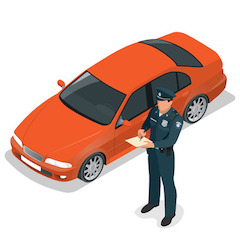
A person who is arrested for driving under the influence is confronted with two problems. First, he faces criminal penalties imposed by a court of law. At the present time, a first offense of DUI is categorized as a Class A misdemeanor offense. The potential penalties include up to one year in jail and a maximum fine of $2,500.

Second, a DUI offender faces civil penalties. A DUI case in which the offender refused or failed chemical testing (such as the breathalyzer) will result in an administrative penalty imposed by the Secretary of State. A person will receive a statutory summary suspension of his driver’s license that goes into effect after 45 days.

But most important, there is the possibility that the offender can have his driving privileges revoked. This is the ultimate penalty for DUI.

Defense attorneys and prosecutors will argue about which penalties are the most severe. Opinions will differ on whether jail or community service is more difficult. My opinion is that a revoked license is the penalty with the most impact.

Generally, a person cannot function without a driver’s license. In the state of Illinois, a person who does not have the right to drive will suffer economic hardship. It will be nearly impossible to obtain gainful employment and support one’s family. For example, it will be impossible to transport family members to and from medical care, or transport children to and from school. The loss of driving privileges will affect everyone in the household.

Perhaps the only exception is where the person lives in downtown Chicago, which has adequate public transportation. But living and raising a family in Chicago is just not financially feasible for many people.

Without question, the ultimate penalty for DUI is a revoked license.

And a revoked license can happen on the first offense.

The law that allows the Secretary of State to revoke an individual’s driving privileges is the following:

Except as provided in this Section, the Secretary of State shall immediately revoke the license, permit, or driving privileges of any driver upon receiving a report of the driver’s conviction of any of the following offenses:

Violation of Section 11-501 of this Code or a similar provision of a local ordinance relating to the offense of operating or being in physical control of a vehicle while under the influence of alcohol, other drug or drugs, intoxicating compound or compounds, or any combination thereof.

625 ILCS 5/6-205(a)(2).

The Secretary of State is required to revoke the driving privileges of any person who is convicted of DUI. There is no way to get around this law. The only way to avoid a revoked license is to avoid a conviction for DUI.

I try to refrain from expressing my opinion on these cases in my articles. But this is one instance in which it is appropriate.

My opinion is that a lawyer who represents a client in a DUI should regard the DUI as though it is just as serious as any felony. In a felony case, the client could go to prison.

In a DUI case, the client could have his driver’s license revoked. I am convinced that in a way, a revoked license is a more serious issue than a prison sentence.

The reason is, a prison sentence will last for a definite period of time. Except in cases of a natural life sentence, every prison sentence has an ending. At some point, the client gets paroled and goes home.

A revoked license, by comparison, has no ending. While it is true that a revoked license is supposed to last for one year, the truth is that it can last indefinitely. A revoked license will last until that person goes before the Secretary of State Department of Administrative Hearings. Revoked driver must undergo a formal hearing and prove by clear and convincing evidence that he should be reinstated.

Click here to download the application for hearing.

It is reported that 80% of people who apply for reinstatement after revocation for DUI are denied on the first attempt.

This is the reason why every DUI case should be regarded as a felony, and treated with as much attention.

New law in Illinois regulates municipal towing fees and procedure for DUI

February 10, 2012
Thumbnail image for New law in Illinois regulates municipal towing fees and procedure for DUI

State lawmakers changed the Illinois Vehicle Code for 2012 to regulate how municipalities tow vehicles after an arrest for driving under the influence. The police practice of towing a vehicle after a DUI arrest has been generally unregulated by state law until now. In the past, each city had its own procedures for towing, the [...]

Read More…

Explaining the Illinois DUI evaluation process

January 22, 2012
Thumbnail image for Explaining the Illinois DUI evaluation process

Driving under the influence is the only offense in Illinois that requires the offender to undergo an evaluation before sentencing. The evaluation is mandated by statute. There is one exception to this rule, and it shows how seriously the law treats a DUI. The only other case in which the defendant is required to have [...]

Read More…

Penalties for a first DUI in Illinois in 2012

January 16, 2012
Thumbnail image for Penalties for a first DUI in Illinois in 2012

We return in 2012 for an update on the law against driving under the influence in the state of Illinois. While crimes such as domestic battery, theft, and murder have not changed in decades, the laws on DUI are changing every year. The statute that prohibits driving under the influence of alcohol or drugs remains [...]

Read More…

Activist group pays cash to people reporting DUI

December 23, 2011
Thumbnail image for Activist group pays cash to people reporting DUI

Call the cops on a drunk driver, win $100. This is the Drunk Busters program in Illinois sponsored by the Alliance Against Intoxicated Motorists (AAIM). Drunk Busters started in Illinois in 1990 and has spread nationwide. AAIM promises to pay $100 to anyone who calls 911 to report an intoxicated driver and later the call [...]

Read More…

Why DUI arrests in Illinois have decreased

December 20, 2011
Thumbnail image for Why DUI arrests in Illinois have decreased

The Chicago Tribune ran a story on drunk driving arrests on December 19, 2011. The article discusses how the numbers of arrests for driving under the influence statewide have decreased over several years. A few points from the article should be examined. First, the Illinois Department of Transportation (IDOT) reports that from 2007 through 2010, [...]

Read More…

DUI charge reduced to reckless driving not completely accurate

December 3, 2011
Thumbnail image for DUI charge reduced to reckless driving not completely accurate

A preferred outcome in many driving under the influence cases is reckless driving. The reason is reckless driving does not impact a person’s driving privileges in the same way as a DUI. The Secretary of State is mandated by law to revoke the driver’s license of any person who is convicted of DUI. The statute [...]

Read More…

Driver’s license suspension and DUI: not related

Thumbnail image for Driver’s license suspension and DUI: not related November 8, 2011

One issue from an arrest for driving under the influence that is confusing is the difference between the summary suspension and the criminal offense of DUI. Many people believe that if you are found not guilty of DUI, then your driver’s license will not be suspended.  This is not true. Unfortunately, the law on DUI [...]

Read More…

Advice on what to do after a DUI and choosing an attorney

October 20, 2011
Thumbnail image for Advice on what to do after a DUI and choosing an attorney

Every person who is arrested for driving under the influence goes through the same process of evaluating what happened, and then deciding how to respond. On the day following the arrest, the first priority is usually getting the vehicle out of impound. After that comes the unpleasant experience of explaining the situation to a spouse, [...]

Read More…

Summary suspension and supervision: not the same

September 8, 2011
Thumbnail image for Summary suspension and supervision: not the same

Many people are confused about the difference between a summary suspension and supervision. The two may sound alike, but they are very different. A summary suspension concerns your driver’s license. Your license to drive is suspended usually 46 days after an arrest for driving under the influence. The suspension is called a statutory summary suspension. [...]

Read More…